The way businesses make and manage phone calls has changed considerably as traditional telephone networks give way to digital communications. Today, a business can handle calls through an IP desk phone, computer or mobile device while keeping the same business numbers, extensions and call-handling features across different locations.
For businesses in Ireland, this shift has also made terms such as 'broadband phone', 'VoIP' and 'digital phone' increasingly common. But what do these terms actually mean, and how does a phone service delivered through a broadband connection work in practice?
Key Takeaways:
The handset is the small decision, the platform is the big one.
Whether staff use a desk phone, laptop or mobile matters far less than the calling system behind it. Devices can be swapped; the platform is what you're really buying.
Your broadband becomes critical infrastructure.
Old analogue phones often worked in a power cut. A VoIP system needs power and internet, so a failover plan is part of the phone decision, not an extra.
Broadband speed alone tells you very little.
What matters more is the connection type available at your premises, how many people, devices and applications share it, and how much a short outage would cost you.
What is a Broadband Phone in Ireland?
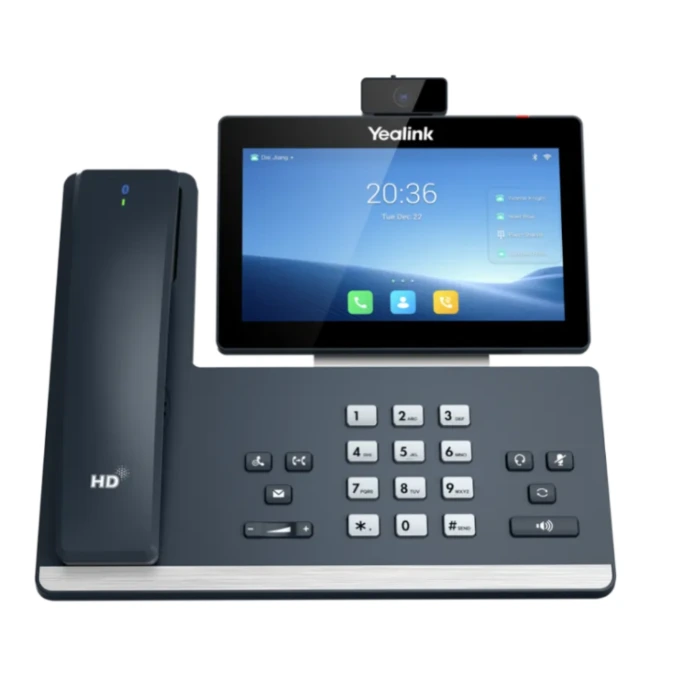
The technology of broadband phone in Ireland refers to a phone service that uses a broadband or internet connection to make and receive calls rather than relying on a traditional telephone network. In Ireland, you may also come across terms such as 'voice over broadband' (VoBB), 'VoIP', 'digital phone' when looking at these services.
The technology behind this is generally VoIP (Voice over Internet Protocol). It converts voice into digital information and transmits it over an IP network, using the broadband connection to carry the communication.
A broadband phone does not mean you have to make calls from a laptop. Depending on the setup you can use:
IP desk phone: hardware built for VoIP, with programmable keys, extension dialling and headset support. Yealink, Snom, Cisco and Fanvil are common in Irish offices.
Standard analogue handset: Connected through an ATA (analogue telephone adapter) rather than a wall socket. Useful when you have handsets you are not ready to replace, or a fax or PDQ machine still in use.
Desktop softphone: An application on a Windows or Mac, usually with click-to-dial from your CRM.
Mobile app: A mobile answers on your business number, not the employee's personal one.
The handset is the smallest part of the decision. What you are really buying is the platform behind it. The broadband connection, calling platform and devices work together to deliver the overall phone service.
How Does a Broadband Phone Work?
With a traditional telephone service, calls are carried through a dedicated telephone network. Broadband-based calling takes a different approach by using an internet connection to transmit the communication.
Your voice > phone or device > VoIP system > broadband connection > recipient
The device used at either end can vary. A business may use IP desk phones for employees in the office, while remote workers use desktop applications or mobile apps to access the same phone system.
The wider phone platform can also manage features such as extensions, call routing, voicemail, call queues and business numbers. This makes modern broadband-based telephony considerably more than simply making a phone call over the internet.
Each concurrent VoIP call requires approximately 100 Kbps of upload and download bandwidth. For most Irish SMEs already using cloud tools, video conferencing, and file sharing. So standard business broadband handles these tasks without difficulty.
Broadband Phone vs Traditional Phone Line: The Key Difference
Can You Use a Normal Phone With a Broadband Phone Service?
Moving to a broadband-based phone service does not necessarily mean replacing every existing handset. Phone services delivered over fibre broadband using VoIP can still work with a standard telephone handset. Instead of connecting the handset to a traditional telephone socket, it connects through the internet modem. The exact equipment and setup depend on the provider and service.
Businesses have additional options. Dedicated IP phones are designed specifically for internet-based calling and can provide features suited to professional environments, while desktop and mobile applications give employees another way to access the same business phone system.
This flexibility can be particularly useful when a business needs more than basic inbound and outbound calling.
When Does Connectivity Matter More as a Business Grows?
The connectivity requirements of a growing business can look very different from those of a small team.
As an organisation expands, it may have more employees making calls, additional departments, higher call volumes, more cloud applications and several devices connected to the same network. It may also introduce remote working or open additional locations. That makes the broadband connection part of a larger infrastructure decision.
A scalable business phone system should therefore be considered alongside the way employees actually work.
“Adding users should not mean completely rebuilding the communications setup, while opening another office should not require a separate and disconnected phone environment.”
Modern cloud-based systems can help businesses add users, extensions and features as their requirements change, making the phone system more adaptable to growth. This is one reason cloud telephony and VoIP are increasingly suited to growing Irish businesses.
Broadband, Remote Working and Multi-Site Businesses
The relationship between broadband and business telephony becomes even more important when employees are no longer working from a single office. A remote employee may need to answer calls using the same business number as colleagues in the office.
A business with several locations may want staff across different sites to share extensions, call routing and other phone features.
Cloud telephony allows these users to connect to the same phone platform through their internet connections. Employees are able to use desk phones, laptops or mobile devices while maintaining a consistent business calling experience.
For multi-site organisations, a unified cloud phone system can also provide centralised management of users, numbers and call settings rather than requiring each location to operate its own isolated system.
This is where broadband becomes more than a general business utility. It forms part of the connectivity layer that allows modern communications to follow the business, wherever its people and offices are located.
What Should a Business Consider Before Choosing a Broadband-Based Phone System?
Before moving to a broadband-based phone system, it is worth looking at the bigger picture rather than focusing solely on the advertised broadband speed. Below are some key considerations:
What connection type and broadband technology are available at your premises.
What is the capacity, and how many people, devices and applications will use the connection.
How disruptive would a connectivity outage be to your business?
Do you operate from one office or several sites?
The working model, depending on whether employees need to make and receive calls remotely.
Any other phone requirements, including the number of users, extensions, and call-handling features you need.
Future needs and whether the current business phone system and underlying connectivity accommodate additional users and locations.
All these assessments can help you determine whether your existing broadband is suitable or whether your connectivity requirements need to be addressed before introducing a new phone system.
How is Broadband Changing Business Phone Systems in Ireland?
Ireland is retiring the copper telephone network that has carried voice calls for the best part of a century. PSTN and ISDN services run on that network, and they are being replaced by all-IP services delivered over broadband or fibre.
Broadband coverage expanding. The transition is running area by area as broadband coverage expands, with the European Commission's broader target for all-IP migration at 2030. Ireland's official statutory Communications Regulation body “ComReg” has published the regulatory framework that allows copper retirement to proceed under defined conditions, and open eir's Fibre Switch Over programme governs the practical migration.
Stop-sell is already here. In areas where fibre is available, new PSTN and ISDN orders are already restricted. This means:
You may not be able to order a new line, add channels, or move an existing service to a new premises.
Fault repair times on legacy lines lengthen as the network is wound down.
Legacy line rental pricing has been moving upward as the network is decommissioned.
For businesses, this shift is about more than changing the technology used to make a phone call. The important point is not that every business needs the fastest broadband package available. It is that the infrastructure businesses use for communications is changing, and Broadband-based phone systems are increasingly designed around that connectivity.
For an Irish business considering VoIP or cloud telephony, understanding the broadband connection underneath the phone system is therefore becoming increasingly important.
You May Also Like: