Every time a customer calls your business, something happens in the background that most people never think about. A system receives the call, decides where to send it, routes it to the right person or department, and manages everything that follows — hold music, voicemail, call queues, and extensions.
That system is your PBX phone system, and how well it is set up has a direct effect on how professionally your business communicates every single day.
For many Irish business owners, the PBX sits somewhere between a piece of technical infrastructure they know they need and something they have never fully understood. This guide is for those people. Here we explain what a PBX system does, how it works, and why choosing the right one matters more than most businesses realise.
Key Takeaways:
Your phone system is part of your brand, not just a back-office tool.
Every call is a first impression. A missed call, or a dropped transfer tells the customer your business is disorganised. For Irish SMEs, where business runs on trust and personal service, how your calls are handled shapes how people see you.
The real cost of an old PBX isn’t the hardware. It’s how slow it makes you.
With an on-premise system, every small change needs an engineer and often another bill. A cloud PBX lets you make those changes yourself in minutes. Your phone system grows with your business instead of forcing a costly upgrade right when you’re busiest.
Small business can sound as professional as a big one, only if it’s set up well.
Features that used to be enterprise-only (call queues, auto attendants, call recording, analytics, working from anywhere) are now affordable for a two-person team. Setting up the menus, queues, and after-hours rules properly is what makes the difference.
What PBX Actually Stands For and What It Means
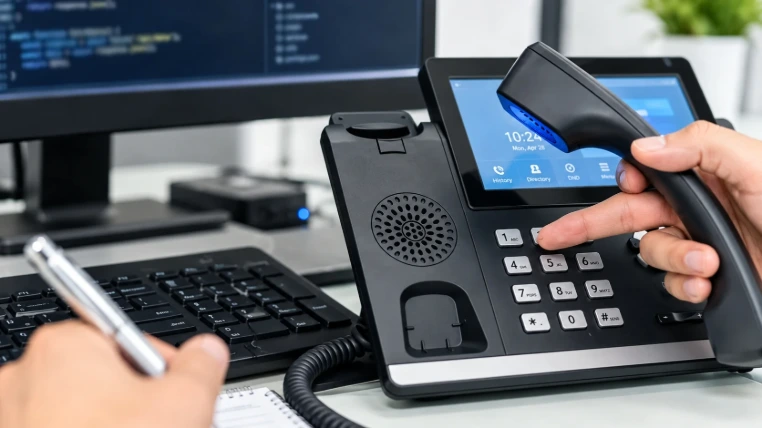
PBX stands for Private Branch Exchange. The name comes from the early days of telephone systems, when businesses needed their own internal exchange as a switchboard to connect calls between employees without routing every call through the public telephone network.
The core idea has not changed. A PBX phone system is still, at its most fundamental level, a system that manages calls within your business and connects you to the outside world. What has changed dramatically is how that system is built, where it runs, and what it can do.
A traditional PBX was a physical hardware, that is often a large, expensive box installed in a server room or communications cupboard. It required specialist installation, ongoing maintenance, and a significant upfront investment. Adding a new user or extension meant a call to the engineer and, often, another bill.
A modern cloud PBX does the same job with better features, such as managing extensions, routing calls, handling voicemail, running auto attendants, but it does it through a secure internet connection rather than a physical box on your premises. The system lives in the cloud, managed remotely by your provider, and your team can connect to it through IP desk phones, mobile apps, or softphones on their laptops.
What a PBX Phone System Actually Does
Understanding what a PBX system does is easier when you think about what happens during a typical business call.
A customer dials your business number. The PBX receives the call and, depending on how it is configured, does one of several things.
It might present an auto attendant menu like “Press 1 for sales, press 2 for accounts” and route the caller based on their selection.
It might ring a specific extension directly.
It might join a call queue if all available team members are busy.
If nobody answers, it might forward the call to a mobile or send the caller to voicemail, which then arrives in your inbox as an email.
All of this happens in a matter of seconds, invisibly, and consistently — every time someone calls.
When it works well, your callers experience a business that feels organised, professional, and responsive. When it does not work well, they experience missed calls, confusing menus, dropped transfers, and the impression that your business is harder to reach than it should be.
A good PBX phone system comes with a core set of features that, once you have them, you will wonder how you managed without. Here is what that typically looks like in practice:
1. Extensions and internal calling
Every team member gets their own extension. Need to transfer a call to someone in accounts? One button. Want to check in with a colleague without using your mobile? Done. No external lines, no extra cost, no routing calls out and back in again unnecessarily.
2. Auto attendants and IVR menus
That professional greeting callers hear when they ring your business — “press 1 for sales, press 2 for support” — that is your auto attendant. It routes callers to the right person or department automatically, which means your team spends less time answering misdirected calls and more time doing actual work.
3. Call queues and ring groups
When things get busy, calls do not just bounce to voicemail and disappear. They join a queue, or ring across a group of available team members simultaneously. It is a simple thing that makes a significant difference to how many calls your business actually answers.
4. Business hours routing
After hours, on weekends, on bank holidays — once your opening hours and holiday schedule are set, calls are handled automatically. It just works. Your PBX system knows when your office is open and what to do when it is not.
5. Voicemail to email
Missed calls do not get forgotten. The voicemail lands directly in the relevant team member’s inbox, where it is easy to pick up, listen back to, and act on — even if they are away from their desk.
6. Call recording
For teams that deal with customers regularly, being able to record calls is genuinely useful. It can be useful for training new staff, reviewing how a complaint was handled, or keeping a record for compliance purposes. It is one of those features that feels optional until the day you actually need it.
7. Multi-device calling
Under the same business number, your team members can make and receive calls on desk phones, mobile apps, and desktop softphones. That’s called multi-device calling.
The Difference Between On-Premise PBX and Hosted PBX
This is where the decision that matters most for Irish businesses comes in.
An on-premise PBX is installed physically at your office. You own the hardware; your IT team or a specialist engineer maintains it, and any changes like adding users, updating call flows, expanding capacity require specialist knowledge. For large enterprises with dedicated IT resources and highly specific requirements, this model can still make sense. For the vast majority of Irish SMEs, it is an increasingly difficult case to make.
Hosted PBX in Ireland works differently. Your PBX system lives on secure servers managed by your provider — in Pulse’s case, a fully Ireland-based infrastructure with 99.99% uptime and local support. You access it through the internet.
Adding a user takes minutes through an online admin portal. Changing your call routing or updating your auto-attendant does not require an engineer on-site. If a team member works from home, they connect to the same system through their mobile app or laptop softphone as seamlessly as if they were sitting in the office.
Practical Advantages of Hosted PBX for Irish SMEs:
1. No PBX hardware to buy
There is no physical PBX box to purchase, install, or maintain. The infrastructure cost is absorbed into a predictable monthly subscription.
2. Scalability without complexity
Adding or removing users is a straightforward administrative task. Your PBX phone system grows with your business at your pace.
3. Built-in business continuity
Because the system is cloud-based, there is no PBX hardware on-site to fail. If your broadband has an issue, calls can automatically divert to mobile numbers so your business keeps operating.
4. Remote and hybrid working support
Your team can make and receive calls on their business number from anywhere in Ireland. From home, on the road, or while travelling, wherever there’s a good internet connection. Wherever your team works, a reliable internet connection is all they need for clear, professional calls.
What Hosted PBX Or Cloud PBX in Ireland Looks Like in Practice
Hosted or Cloud PBX in Ireland is not a new concept, but the quality and accessibility of hosted solutions have improved substantially in recent years. What was once the preserve of larger enterprises is now straightforwardly available to businesses with two employees as readily as those with two hundred.
The whole system is set up and managed remotely, requires no on-site hardware beyond desk phones or mobile apps, and costs a fraction of what a traditional PBX installation would have cost ten years ago.
For a growing SME, the same platform scales to accommodate a sales team with call queues and performance reporting, a customer support function with structured call handling, and a management layer with real-time call analytics — all within the same system, on the same monthly subscription model.
A well-configured cloud PBX does not just replace your old phone system. It gives your business communication capabilities that simply were not available or affordable to SMEs before the shift to cloud telephony.
Why Getting Your PBX Right Matters More Than You Think
A phone system is easy to underestimate. It runs in the background; it is not customer-facing in an obvious way, and when it is working, nobody notices it. But when it is not working or when it is set up poorly, the effect on your business is immediate and visible.
Missed calls are lost opportunities.
A confusing auto-attendant menu frustrates callers before they reach anyone.
A team member working remotely who cannot receive calls on their business number creates gaps in your customer service.
A phone system that cannot scale forces you into a costly and disruptive upgrade at exactly the moment your business is trying to grow.
Getting your PBX phone system right from the outset means those problems do not arise. It means your team is reachable wherever they are working. It means your callers experience a business that is professional, organised, and responsive. It means your communication infrastructure grows with your business rather than holding it back.
For Irish SMEs in particular, where the relationship between a business and its customers is often built on trust and personal responsiveness, the quality of your phone system is not a back-office detail. It is part of how your business presents itself every time someone picks up the phone.
You May Also Like: